Showing posts with label self-publishing. Show all posts

2013-05-03

Difficult to Categorize | 7 | Have I Transgressed?

Practically at the very moment of release from my strangulating 6-month Kindle Select exclusive, I finally published the Smashwords edition of Middlemarch. Which means that in a few more days it will be available for iPads and Nooks and phones and everything—digital saturation. I’ve been all over the Kindle Direct Publishing site and the Smashwords dashboard among the files at my accounts doing this. I’ve checked the sales data. I haven’t made any sales at all.

But I persevere! After two weeks of tinkering I’m finally happy again with the front page of my web site. I’m content to stop, despite the dead javascript in Her Attractive Pain and Cloak which I just don’t know how to fix (and it’s still alive in Explorer). My work so far is there, the best I could do at the time. Of course it’s not everything. I’ve got cartons of writing on paper. Lots of the old stuff is on typing paper—typed!—and a great deal else (including a novel) printed from files stored inaccessibly throughout a deep wooden desk drawer full of different-sized disks; I’ve got hardware to match piled in corners and closets, busted and unsupported. To put more old work on-line, I’ll have to re-type it.

Throw rice!
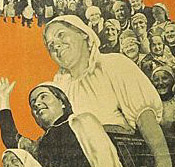
In early 2001, when I could still open some of those old files, I converted two of them into web projects to build out RIP-TV beyond the diaryland site. An episodic autobiographical piece about my luck (bad) with women, One and Others was written and pieced together over the course of many years. The web version is the first complete one; it’s organized around several views of a painting of my sister’s that I keep above my desk. The title is stolen from a small-scale wooden sculpture by Louise Bourgeois that I first saw with my after-college girlfriend (who’s in the story) at MoMA in the 1982 one-woman retrospective, an unforgettable show. Not long ago I saw One and Others again, it’s on Madison Avenue in the Whitney’s permanent collection, near the bathrooms; I recognized it right away coming out. In tribute to its undimmed allure, I’ve replaced the Soviet work propaganda that I’ve been using as the linking “tile” at RIP-TV with a photo of the thing itself.


The site’s other pre-digital story, Girls School, I wrote start to finish in the fall of 1995 as my contribution to a lesbian writing workshop I was taking with nice lesbian friends in Central Square, Cambridge. It was composed under the influence of a cover-to-cover Columbus Day weekend reading of Harold Bloom’s The Western Canon that I did on my own. Which (the Western canon, especially Macbeth) remains to me what Girls School is about, although it is a lesbian porno climaxing in a sex ritual. I did a serial on-line publication, each installment illustrated with a collage made from an image in the Taschen paperback 1000 Nudes. For years I’ve had the finished version linked to a lesbian pair study from the same source with a Constructivist graphic cut into one of the bodies, an image I consider ample warning; I’ve kept and cropped it for the latest front page design.


May 2013 and I’ve had those two stories on my web page which I’ve shared widely for over a decade; I always put my web page address on my business resume, too. But somehow until recently I thought So what? about that. I wasn't unaware of how I was outing myself, but I was indifferent. The lesbian thing wasn’t really my focus; I was interested in writing in different voices and crafting hypertexts and creating on-screen beauty. In my work the lesbianism was content, it was just one type of subject matter among many contributing to the flow of words: this is how I saw it. Maybe writing Middlemarch changed me—anyhow my point of view has changed. The lesbianism looks extremely significant to me at the present time. Of course I’ve always realized that vast numbers of people can’t tolerate lesbians at all, not even the marrying child-rearing kind and certainly not the sex ritual enacting kind. I don’t care at all about these people’s feelings, but being more aware of them makes me care more about lesbians. I want to support and encourage lesbians in their lesbianism through an offering of literature. I hope it helps.


So at last I’m posting Middlemarch on Smashwords, and here comes the category choice. In support of lesbianism I go with Fiction—Gay & Lesbian—Lesbian for the primary listing and Fiction—Historical—USA for the back-up. Literary Fiction I passed by, as planned; Women’s Fiction tempted me, Women’s Fiction—Feminist tempted me. The category that sounded most fitting, I didn’t choose either: Fiction—Literature—Transgressional. But the first time I saw that category, it seemed to flash.

It felt almost too fitting. What doesn't Famepunk Part 2: Middlemarch transgress? Look what it does to the historical record, for starters! Crossing lines everywhere, crossing all the lines, violating all the boundaries, walking into lines of nightsticks on every hand: my book does this with its tits out. It’s ridiculously transgressive. I mused. Transgressional: maybe these are my people.

Me
Then I thought, Hey, wait a minute. What’s with Transgressional? What happened to Subversive? So I looked and there’s no category line for Fiction—Literature—Subversive or for anything Subversive. That category—a genuine category, one of long standing and high repute in many circles, historically important circles—is gone, it’s missing; Subversive is history. To say, I have set out to undermine a faulty structure and help to bring it down isn’t the choice now. Instead, I transgress: the focus of agency shifts from the structure to the property lines, from cores to boundaries, from danger to nuisance, naughtiness. Why should this be? Subversive is maybe passé, too blunt and opinionated, too butch, too innocent, maybe; Transgressional offers the almost to subversive’s too much for the sensitive 21st-century ear. Maybe this is the thinking, that Subversive has evolved, that it’s gained self-awareness and done some re-branding and now it’s Transgressional. Its politics informed by psychology, recognizing protest as neurotic symptom, it prods the reasonable walls until they bite.

I’d have loved to label Fampunk as subversive literature (which it might be) and fight it out with the competitive anarchists and would-be Kaczynskis for a readership.

2013-04-11

Difficult to Categorize | 3 | Is it LGBT?

Yes!

An uncategorical chorus of up-votes for that one. Both Famepunk Part 2: Middlemarch and its precursor Part 1: US Open 1987 are extremely LGBT. There’s all the many lesbians plus gays throughout, along with definite bisexuals and at least one pivotal character who’s sexually transitioning. Start to finish, I’ve got this category covered.

Yet I didn’t publish Part 1 as LGBT (I put it up in the Sports Fiction category) specifically because that book contains no more than a smidgen of one lesbian sex scene not even involving the lead characters and I figured anyone coming for LGBT would want more sex. Because I would. That being, in my mind, the main part of the pact between LGBT author and reader, who through the magic of publishing meet in a space with that sign right on the roof: LGBT. Meaning: Here will be sex of that kind described; lesbian, gay, bisexual and/or transgendered sex acts will be depicted. For me and I suppose for my cohort, whoever we are, having the LGBT option at all makes the ADULT and Erotica tags feel strangely redundant and hair-splitting.


Is this generational? As I reflect, now, I recognize that to touch and arouse sexual feelings might appear as a chore and not a duty to the modern-day LGBT writer. Who might just want to write about characters while steering clear of their sex lives; maybe they want to write LGBT action with no sex at all—only, antiquing or something. Solving or committing murders at major antiques shows or racecourses. Teaching at a local community college while also being a shape-shifter. It’s possible. Writers who might have decided that if there were sex scenes they’d call it ADULT and stamp it Erotic but there are not, there aren’t any sex scenes, such writers could be publishing novels at this very moment and tagging them LGBT without a qualm. For all I know, Middlemarch with its shameless excess in the lesbian sex scene department might be greeted like an interloping pervert in the normal, default, ADULT-filtered LGBT catalogue—where the unwary moms of school-aged children go to buy their lesbian books, an old exhibitionist slouched in a playground raincoat.

2013-04-07

Difficult to Categorize | 2 | Is it ADULT?

The fact is that Famepunk Part 2: Middlemarch concerns the birth and progress of a passionate, comical, highly combustible love affair between two teenage girls who also happen to be competing as champions on the international tennis circuit in 1988--and it contains a great deal of lesbian sexual content. It just does. In the Famepunk series, this is the book about young dumb love, the modern take on Romeo & Juliet & Heathcliff & Cathy; like Twilight. Except—importantly! importantly!—with actual sex scenes and lesbians. Lots of and quite long scenes, too, this book is 800 pages long.

RIP Roger Ebert 1942-2013
I don’t mean to exaggerate. Middlemarch is not a porno. It has erotic moments (many) but it’s not erotic like Judith Krantz’s Scruples, for instance, or The Story of O or Anne Rice’s Beauty novels. All of which, yes, while admiring them I would vote YES to save aside in the adults’ reading room at the public library as in the North American home. But Famepunk? Tons of sex, sure, but all plot-driven, not the plot itself. There are many other things that happen, many other characters. Ronald Reagan appears in a phone call, for goodness sake—there’s a potluck buffet in a Panhandle church basement. You ask me, is Famepunk Part 2: Middlemarch for adults? I answer: Certainly—all adults! All adult readers are welcome.

But is it ADULT?

I spend some days slightly flummoxed by this question. I’ve returned to Smashwords and as directed in the FAQ, I’ve clicked the homepage adult content filter ON to OFF. I see what they’re getting at right away when “Criss Cross Romance Short Story” gets replaced by “Fuck the Foreplay” at the top of the Gay & Lesbian Most Downloaded list; there are many additional lesbian ADULT titles to browse. I've now read two, one set in Japan and the other written by an extremely prolific young man from Oklahoma (male authors have always written a lot of the lesbian fiction that sees the light of day).

Clicking the ADULT box while publishing a book in the Lesbian Erotica category, as the hard-working author of Daisuki did, I can understand—if I believed Middlemarch belonged there, I'd do it, too. But what the hell motivation lies behind clicking the ADULT box for a book with hardly any sex? I’m mystified—although I assume there’s some concerted effort going into the pursuit of horny reader dollars, the ADULT tag here advertising the presence of sex to an audience that favors, for whatever reason, softcore material. Finally it hits me. This is the ADULT from the cable TV warning: The following program contains adult subject matter. Viewer discretion is advised. This is that category, out in the world now, inside writers’ heads, as a question: Would that warning be required up-front if their novel were a TV movie?

First: for Famepunk, yes, naturally. But: I do not accept that category. I think it’s bogus. I decry the strain of self-censorship it fosters, the infiltration of private imagination by market forces that it both invites and represents. I believe all art works, including those created for children, should aspire to excite interest and pleasure among the most sophisticated and discerning "grown-up" adults available. Only books that have no hope of doing so should come with warnings, in my opinion.

2013-04-02

Difficult to Categorize | 1 | Is it YA?

I've been polishing these second editions and preparing files for print and re-formatting them for Kindle and formatting them some more for Smashwords through which I'll distribute to iStore and Nook. In the midst of doing this I find I'm still locked into Amazon’s exclusive-to-Kindle program for Famepunk Part 2: Middlemarch, dating back to when I'd published it for Kindle on the day before the hurricane, back in October; I really rushed out that first edition in case something happened. As usual not reading the fine print but especially not with a hurricane coming I missed the part about automatic renewal—I just went naturally for the 70% royalty and figured I could wait three months before putting it on Smashwords. Three months I do standing on my head, easy. But five months later I've made a lot of changes, I'm happy with the results, and I want to get both these books “out there” so I can move on to the next one. Period. Instead, because I missed the renewal, I’m back in month two again—five months, by the way, with nothing to show, 70% of nothing, zero. Annoyed with myself and none too pleased with Amazon or its customer base, I've unchecked the proper on-screen box and will be free at the end of April to complete its publication process when I post Famepunk Part 2: Middlemarch on Smashwords. Where, I've noticed, I'll have to check a different box to say whether it contains content unsuitable to be seen by readers under 18 years of age, or not.

What strikes me first about that is 18 being a high cutoff. As a young lesbian, say even at 14 or 15 I'd have seized on and embraced a book like this with all my attention, I’d have read it straight through on a school night, seriously. Granted I was intellectually precocious but lesbians are often intellectually precocious, this is not a necessary sign of lesbianism but it's an indicator. I think it might have done me some good, too, to read this book at that age. By 18, I'd already slept with the wrong woman—and I was not precocious sexually. Kids these days, not uncommonly, I've heard things, today’s 17 year-olds would be the equivalent to what childless divorcees represented experientially in my own youth.

Bieliebers: They just love that lesbian boy.
So, no. Even though the book is one big vast and tumbling cornucopia of lesbian erotic thoughts and deeds including public sex, rough sex, and masturbation, I wouldn't call it unsuitable for readers between 13 and 17 years of age. It’s a book about teens and that’s the kind of sex teens have—in real life. They know this. So is Famepunk Part 2: Middlemarch written for teens? No. Is it YA? Of course not. It isn't. Should teens read it? I say yes, if only because it will take them all a great many hours they would otherwise spend texting each other about blow jobs and cyber-bullying schemes, if media is to be believed. (It isn’t.)

2012-11-18

A Long Self-Blurbed Book

I’ve written this massively long book in complete isolation and I have no one to blurb it. Which is ridiculous, really: while I was extremely busy writing Famepunk Part 2: Middlemarch, I’ve also had over a year since publishing the first part to gather comments and support and plant excitement and harvest something in the way of a blurb. I also had the desk time—which I wasted surfing the internet at my day job, instead.

So maybe I should re-phrase: I’m a feckless isolated internet-addicted loser writing a massively long book. It’s such an excellent book, though, I can’t seem to feel like a loser even when the evidence is right there confronting me. It’s like I live in a dream world—but I don’t. I’m awake, I understand the modern age. Indeed, I wrote promotional copy as part of my living for years, as in fifteen or twenty years. There I sit, at my job, day after day, there I sit on my skills, checking in and out of videogum and dlisted where, yes, the writing is excellent. But in the mornings, among other publications where good prose is not exactly a watchword, I read The New York Daily News and The Root. Seriously, it’s absurd the quantity of time I’ve fapped away like Octomom (credit and thank you, Michael K) that I could have spent on self-marketing; it’s a real failure of mine, to have let my isolation feed upon itself and grow this way
 
For here I am, as a result, shopping another product that’s entirely missing “The Best Book by Any American!—Zadie Smith” on any portion of its surface. I’ve got another self-written blurb on my book cover which is not exactly “A magical realm—primeval powers battle—in this page-turning delight—an instant classic” either. Even if all this were more or less true (it is) I cannot, as my own publisher, make that sort of claim on the book cover. It would look too shabby, or shady—too L. Ron Hubbard-y—too desperate and crazy. Too sad, pretending to have a publisher’s enthusiasm behind me when all I’ve really got is talent, pluck and an internet connection.


TWO BIRDS WITH ONE STONE:
Tom Hardy for mass marketing and Fairness Doctrine purposes