Until the end of July, customers at Smashwords can get all three volumes of Famepunk for one low price of $7.50. The first two books are 50% off and the last one is FREE! Use code SSW50 at checkout.

2014-07-08

2014-07-06
After Wimbledon | Ladies
The scary Canadian tennis player Eugenie Bouchard hasn't managed to inspire any warm feelings in me in the couple of years since her star began to rise. She is aggressive and antique portrait bust pretty, very Gilded Age; other fans of Edith Wharton might have noted her exact-in-many-points resemblance to Undine Spragg. Yesterday at Wimbledon she played and was flattened 6-3 6-0 in the Ladies Single final. Even though I am a major Petra Kvitova fan, here was my chance to loosen the heartstrings and sympathize with the kid a little; I didn't, I enjoyed watching North American princess type Eugenie Bouchard get thumped and sent packing in less than an hour by "my" player. Very much!
 |
Petra Wins Again
|
But ever since, when I think about what she was up against, thinking back on that match, I've felt more and more sorry for Genie Bouchard. In my mind's eye I can picture her, a pretty blonde girl with visor, braid, racquet, white multi-million dollar Nike contract tennis dress, the works--she's on one side of the net. And on the other side, I know, is Petra Kvitova, I've watched the match twice (on-line, via ESPN embedded on the Wimbledon site all the way through the finals, all courts, with replay, very civilized and great despite buffering problems). And I see Petra Kvitova; she just hit a crosscourt forehand. At the same time a spirit photography-style double exposure occurs in my memory and hovering all around her I see white brick walls and parts of industrial structures--concrete loading docks, power plant smokestacks, thick steel beams with rivets for their alien double spines. As I recall, I see poor Genie Bouchard with no weapons but a strong chin versus some kind of dark Satanic Mill, a human female mega-factory for the production of another Wimbledon title.
2014-03-02
Hard, Fast and Beautiful
At a time (now, 2014) when women’s professional tennis is so rife with incompetence, gutlessness, malingering and fakery as to be practically unwatchable, I’ve turned to The Vaults. It’s possible to find quite a few interesting old matches on-line; the Australian Open posted some great ones on its web site that I watched during this last tournament, for instance.
And then there’s fiction.
Hard, Fast and Beautiful is a 1951 film directed by Ida Lupino (who was also an actress, of course) for RKO Pictures. It traces the meteoric career of a young tennis player who wins the women’s singles title at the US Open, only to find her hopes and dreams jeopardized and almost crushed by the machinations of her horrible mother. I will spoil the ending now by saying that in the end the young player quits and goes off in the arms of her fiancée, who promises to be a good earner.

The mother, played by Claire Trevor, is the star of the story. She is a cold bitch with a rotten character and an addiction to status, smoking, cocktails, fur coats, fancy hotels and basic cash money. Which is a problem for her because in the “pre-professional era” of international tennis, which didn’t actually end until 1968, tournament play was reserved for amateur athletes. The four “majors”—Wimbledon, Roland Garros, the United States Open, the Australian Championships—and other title events around the US and the world, did not offer prize money. If you won, you got a cup. If you wanted to make money playing tennis, you went “pro” and played against other pros on one of the exhibition circuits. (In 1952’s “Pat and Mike,” Katherine Hepburn’s character plays pro tennis, appearing at one point against Alice Marble who won many Grand Slam titles as an amateur; she also spied against the Nazis until she got shot in the back and had to go home.) Pro matches could be quite competitive but professional tennis wasn’t considered or expected to offer true competition in the sense that amateur tennis did.
So poor Millie Farley (the mother) does what she can to leverage her champion daughter’s world-class but non-paying titles into a living. She joins forces with a suave scumbag talent scout-manager-promoter and in no time at all her daughter’s getting free racquets, free clothes, and big checks made out to “Cash” from major hotel chains who want her as a guest. There’s a big mother-daughter confrontation when young Florence Farley wins Wimbledon and comes back drunk from the post-finals ball to their huge suite at the Piccadilly Hotel, where she reveals that none of the other girls get to stay in huge suites and that she’s being ostracized because of her ill-gotten gains. Millie doesn’t want Florence to turn pro—she just wants her to keep winning so that they can keep traveling around the world in luxury. But eventually (see above) this becomes too much to ask and Florence quits. Millie has a downfall.
This movie, its fine acting and dramatic qualities aside, offers a wonderful look back at a vanished world. The US Open scenes were filmed on location at Forest Hills, right in the grass court stadium, and also at the Forest Hills Inn (which still exists, though not as a hotel now, it’s co-ops). All the play is with wooden racquets and it’s extremely good play, complete with lots of strategy and “American Twist” serves. In one montage all the old East Coast tournaments show up—Philadelphia, East Hampton, a couple in New Jersey, there was even one in Essex, Massachusetts. Upper-class white East Coast Yankees (redundant, redundant) coming out to watch white women play tennis, with no money casting its sullying shadow over the enterprise, pure competition—this was the picture of a dream world.
 |
| Forest Hills, Queens |
Of course people always took money. Perks. There must have been a lot of gambling. Match-fixing. The pure amateur was a figure of myth long before the sport was professionalized. Poor Millie, all alone at the end, the bad mother. She has a bad greed problem and that made her a bad person by the stated standards of her day. But looking at the ending of Hard, Fast and Beautiful from the perspective of 2014, when Dominika Cibulkova (a nice girl, no question) got $1,350,000 for winning six games in the Australian Open final, it’s harder to judge, hard not to sympathize.
Maybe the greedy people were simply ahead of their time.
2013-12-26
Partly Free Until Epiphany
Happy Boxing Day! In honor of the season, until January 6, 2014 I will be giving away FREE print copies of Famepunk Part 3: The Lutheran. Just send your mailing address of choice to liz@famepunk.com and give it a week or so.
At your request, I'll send you a BONUS digital copy. . .and if you've already bought a copy of The Lutheran, please let me know. I'll send you a copy of something else.

At your request, I'll send you a BONUS digital copy. . .and if you've already bought a copy of The Lutheran, please let me know. I'll send you a copy of something else.

2013-12-09
A Modern Holiday Classic (Updated)
I spent all summer into October working on a long chapter from Against Theodosia, the next volume of Famepunk. I called it The Lutheran. When it was done, I put it aside for a month. My plan was to publish the chapter as a Christmas-themed Kindle Single and use it to "draw people into" the rest of the series at the buying time of year.
So I spent part of the fall slacking off from being a financially unsuccessful writer. I read a lot and watched movies, it was wonderful. Then I got involved in another writing project, unrelated to Famepunk but still, coincidentally, with Russian and Jewish characters. I was really getting into it but then ran into Thanksgiving. At which point the first Sunday in Advent, my deadline, loomed.
With the help of kind readers (Claudia, Rags & James) I was able to make pretty quick work of the final revisions. The cover design went very smoothly; in PhotoShop I was able to copy over the basics of the previous cover designs, having learned how to do this while making them. Then, on the last morning of the last minute before publishing, I decided that it wasn't a chapter from Part 3--it was a part itself. Which makes it Part 3: The Lutheran.
Like a flash, I finish the cover, prepare all the text files, fiddle fiddle fiddle upload and quickly publish digital versions for Kindle & Smashwords. A week later, Amazon lists the elegant-122 page print paperback version, a nice little slim little self-contained story that skips ahead in the Famepunk chronology to the very end of 1991 when the heroine, Emma Jasohn, is about to have a baby. To some degree, the whole thing really is a Christmas story.

It's also a comedy about the Protestant Church. The lead character (The Lutheran) is a stranger to the Famepunk story who gets hired as Emma's emergency German tutor. He's German and so is his (also pregnant) wife, they both attend Union Theological Seminary where they're honing their skills and qualifications for the Lutheran priesthood. So this is the part of my subversive lesbian global-historial romance that's told from the point of view of a heterosexual male.
Technically, I felt it was the best choice, in large part because it absolved me of having to write so intimate an account of "the process" as I might have attempted otherwise. It wouldn't have been very good. Third trimester pregnancy, amniotic fluids, contractions, labor pains, crowning, placenta--what do I know? I think undergoing this experience sounds horrible.
The thing is, I have never had a baby. I've never wanted to have a baby, care for a baby, raise a baby, at all. Neither does Emma Jasohn, she is unwillingly pregnant, carrying a baby she doesn't want to full term because the people who control her life plan to profit from this baby--which, in her case, will be a celebrity baby, since she's famous and the baby's father is, too. But while I was writing this part of the story I thought a lot about how many girls and woman have babies they don't want, every day the unwanted are born to miserable mothers imprisoned by their own circumstances.
And still those mothers and children turn out okay all the time. So, Merry Christmas...buy a book!
So I spent part of the fall slacking off from being a financially unsuccessful writer. I read a lot and watched movies, it was wonderful. Then I got involved in another writing project, unrelated to Famepunk but still, coincidentally, with Russian and Jewish characters. I was really getting into it but then ran into Thanksgiving. At which point the first Sunday in Advent, my deadline, loomed.
With the help of kind readers (Claudia, Rags & James) I was able to make pretty quick work of the final revisions. The cover design went very smoothly; in PhotoShop I was able to copy over the basics of the previous cover designs, having learned how to do this while making them. Then, on the last morning of the last minute before publishing, I decided that it wasn't a chapter from Part 3--it was a part itself. Which makes it Part 3: The Lutheran.
Like a flash, I finish the cover, prepare all the text files, fiddle fiddle fiddle upload and quickly publish digital versions for Kindle & Smashwords. A week later, Amazon lists the elegant-122 page print paperback version, a nice little slim little self-contained story that skips ahead in the Famepunk chronology to the very end of 1991 when the heroine, Emma Jasohn, is about to have a baby. To some degree, the whole thing really is a Christmas story.

It's also a comedy about the Protestant Church. The lead character (The Lutheran) is a stranger to the Famepunk story who gets hired as Emma's emergency German tutor. He's German and so is his (also pregnant) wife, they both attend Union Theological Seminary where they're honing their skills and qualifications for the Lutheran priesthood. So this is the part of my subversive lesbian global-historial romance that's told from the point of view of a heterosexual male.
Technically, I felt it was the best choice, in large part because it absolved me of having to write so intimate an account of "the process" as I might have attempted otherwise. It wouldn't have been very good. Third trimester pregnancy, amniotic fluids, contractions, labor pains, crowning, placenta--what do I know? I think undergoing this experience sounds horrible.
The thing is, I have never had a baby. I've never wanted to have a baby, care for a baby, raise a baby, at all. Neither does Emma Jasohn, she is unwillingly pregnant, carrying a baby she doesn't want to full term because the people who control her life plan to profit from this baby--which, in her case, will be a celebrity baby, since she's famous and the baby's father is, too. But while I was writing this part of the story I thought a lot about how many girls and woman have babies they don't want, every day the unwanted are born to miserable mothers imprisoned by their own circumstances.
And still those mothers and children turn out okay all the time. So, Merry Christmas...buy a book!
2013-06-18
2013-05-03
Difficult to Categorize | 7 | Have I Transgressed?
Practically at the very moment of release from my strangulating 6-month Kindle Select exclusive, I finally published the Smashwords edition of Middlemarch. Which means that in a few more days it will be available for iPads and Nooks and phones and everything—digital saturation. I’ve been all over the Kindle Direct Publishing site and the Smashwords dashboard among the files at my accounts doing this. I’ve checked the sales data. I haven’t made any sales at all.
But I persevere! After two weeks of tinkering I’m finally happy again with the front page of my web site. I’m content to stop, despite the dead javascript in Her Attractive Pain and Cloak which I just don’t know how to fix (and it’s still alive in Explorer). My work so far is there, the best I could do at the time. Of course it’s not everything. I’ve got cartons of writing on paper. Lots of the old stuff is on typing paper—typed!—and a great deal else (including a novel) printed from files stored inaccessibly throughout a deep wooden desk drawer full of different-sized disks; I’ve got hardware to match piled in corners and closets, busted and unsupported. To put more old work on-line, I’ll have to re-type it.
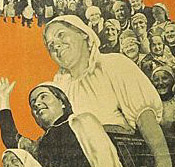
In early 2001, when I could still open some of those old files, I converted two of them into web projects to build out RIP-TV beyond the diaryland site. An episodic autobiographical piece about my luck (bad) with women, One and Others was written and pieced together over the course of many years. The web version is the first complete one; it’s organized around several views of a painting of my sister’s that I keep above my desk. The title is stolen from a small-scale wooden sculpture by Louise Bourgeois that I first saw with my after-college girlfriend (who’s in the story) at MoMA in the 1982 one-woman retrospective, an unforgettable show. Not long ago I saw One and Others again, it’s on Madison Avenue in the Whitney’s permanent collection, near the bathrooms; I recognized it right away coming out. In tribute to its undimmed allure, I’ve replaced the Soviet work propaganda that I’ve been using as the linking “tile” at RIP-TV with a photo of the thing itself.

The site’s other pre-digital story, Girls School, I wrote start to finish in the fall of 1995 as my contribution to a lesbian writing workshop I was taking with nice lesbian friends in Central Square, Cambridge. It was composed under the influence of a cover-to-cover Columbus Day weekend reading of Harold Bloom’s The Western Canon that I did on my own. Which (the Western canon, especially Macbeth) remains to me what Girls School is about, although it is a lesbian porno climaxing in a sex ritual. I did a serial on-line publication, each installment illustrated with a collage made from an image in the Taschen paperback 1000 Nudes. For years I’ve had the finished version linked to a lesbian pair study from the same source with a Constructivist graphic cut into one of the bodies, an image I consider ample warning; I’ve kept and cropped it for the latest front page design.

May 2013 and I’ve had those two stories on my web page which I’ve shared widely for over a decade; I always put my web page address on my business resume, too. But somehow until recently I thought So what? about that. I wasn't unaware of how I was outing myself, but I was indifferent. The lesbian thing wasn’t really my focus; I was interested in writing in different voices and crafting hypertexts and creating on-screen beauty. In my work the lesbianism was content, it was just one type of subject matter among many contributing to the flow of words: this is how I saw it. Maybe writing Middlemarch changed me—anyhow my point of view has changed. The lesbianism looks extremely significant to me at the present time. Of course I’ve always realized that vast numbers of people can’t tolerate lesbians at all, not even the marrying child-rearing kind and certainly not the sex ritual enacting kind. I don’t care at all about these people’s feelings, but being more aware of them makes me care more about lesbians. I want to support and encourage lesbians in their lesbianism through an offering of literature. I hope it helps.

So at last I’m posting Middlemarch on Smashwords, and here comes the category choice. In support of lesbianism I go with Fiction—Gay & Lesbian—Lesbian for the primary listing and Fiction—Historical—USA for the back-up. Literary Fiction I passed by, as planned; Women’s Fiction tempted me, Women’s Fiction—Feminist tempted me. The category that sounded most fitting, I didn’t choose either: Fiction—Literature—Transgressional. But the first time I saw that category, it seemed to flash.
It felt almost too fitting. What doesn't Famepunk Part 2: Middlemarch transgress? Look what it does to the historical record, for starters! Crossing lines everywhere, crossing all the lines, violating all the boundaries, walking into lines of nightsticks on every hand: my book does this with its tits out. It’s ridiculously transgressive. I mused. Transgressional: maybe these are my people.
Then I thought, Hey, wait a minute. What’s with Transgressional? What happened to Subversive? So I looked and there’s no category line for Fiction—Literature—Subversive or for anything Subversive. That category—a genuine category, one of long standing and high repute in many circles, historically important circles—is gone, it’s missing; Subversive is history. To say, I have set out to undermine a faulty structure and help to bring it down isn’t the choice now. Instead, I transgress: the focus of agency shifts from the structure to the property lines, from cores to boundaries, from danger to nuisance, naughtiness. Why should this be? Subversive is maybe passé, too blunt and opinionated, too butch, too innocent, maybe; Transgressional offers the almost to subversive’s too much for the sensitive 21st-century ear. Maybe this is the thinking, that Subversive has evolved, that it’s gained self-awareness and done some re-branding and now it’s Transgressional. Its politics informed by psychology, recognizing protest as neurotic symptom, it prods the reasonable walls until they bite.
I’d have loved to label Fampunk as subversive literature (which it might be) and fight it out with the competitive anarchists and would-be Kaczynskis for a readership.
But I persevere! After two weeks of tinkering I’m finally happy again with the front page of my web site. I’m content to stop, despite the dead javascript in Her Attractive Pain and Cloak which I just don’t know how to fix (and it’s still alive in Explorer). My work so far is there, the best I could do at the time. Of course it’s not everything. I’ve got cartons of writing on paper. Lots of the old stuff is on typing paper—typed!—and a great deal else (including a novel) printed from files stored inaccessibly throughout a deep wooden desk drawer full of different-sized disks; I’ve got hardware to match piled in corners and closets, busted and unsupported. To put more old work on-line, I’ll have to re-type it.
 |
| Throw rice! |

May 2013 and I’ve had those two stories on my web page which I’ve shared widely for over a decade; I always put my web page address on my business resume, too. But somehow until recently I thought So what? about that. I wasn't unaware of how I was outing myself, but I was indifferent. The lesbian thing wasn’t really my focus; I was interested in writing in different voices and crafting hypertexts and creating on-screen beauty. In my work the lesbianism was content, it was just one type of subject matter among many contributing to the flow of words: this is how I saw it. Maybe writing Middlemarch changed me—anyhow my point of view has changed. The lesbianism looks extremely significant to me at the present time. Of course I’ve always realized that vast numbers of people can’t tolerate lesbians at all, not even the marrying child-rearing kind and certainly not the sex ritual enacting kind. I don’t care at all about these people’s feelings, but being more aware of them makes me care more about lesbians. I want to support and encourage lesbians in their lesbianism through an offering of literature. I hope it helps.
So at last I’m posting Middlemarch on Smashwords, and here comes the category choice. In support of lesbianism I go with Fiction—Gay & Lesbian—Lesbian for the primary listing and Fiction—Historical—USA for the back-up. Literary Fiction I passed by, as planned; Women’s Fiction tempted me, Women’s Fiction—Feminist tempted me. The category that sounded most fitting, I didn’t choose either: Fiction—Literature—Transgressional. But the first time I saw that category, it seemed to flash.
It felt almost too fitting. What doesn't Famepunk Part 2: Middlemarch transgress? Look what it does to the historical record, for starters! Crossing lines everywhere, crossing all the lines, violating all the boundaries, walking into lines of nightsticks on every hand: my book does this with its tits out. It’s ridiculously transgressive. I mused. Transgressional: maybe these are my people.
 |
| Me |
I’d have loved to label Fampunk as subversive literature (which it might be) and fight it out with the competitive anarchists and would-be Kaczynskis for a readership.
Subscribe to:
Posts (Atom)